Pilot to Pilot Podcast E355 - Tyler Flagg (Flying Company)


I recently had the chance to join the Pilot to Pilot podcast for a conversation about my background in aviation, my time flying in Air Force Special Operations, my transition into corporate aviation, and most importantly, why I founded Flying Company.
Podcasts like this are always fun because they give you a chance to tell the longer story behind a company. People often see the surface-level version first: a staffing platform, a marketplace, a website that helps connect operators and pilots. But behind that is a much bigger reason the company exists. Flying Company was built because there are real problems in aviation that continue to waste time, create friction, and make life harder for pilots than it should be.
That was really the heart of the conversation.
I spent about 14 years in the Air Force, much of that time in special operations aviation. It was a career that took me all over the world and exposed me to an unusually wide range of flying environments. I flew operationally in dozens of countries, often in situations where adaptability mattered just as much as technical skill. Some missions were straightforward, while others involved the kind of planning, uncertainty, and operational complexity that forced you to mature quickly as a pilot. You learn how to think ahead, how to stay calm, how to manage risk, and how to operate professionally even when the environment around you is constantly changing.
That experience shaped the way I think about aviation. It taught me that flying is never just about manipulating the controls. It is about judgment, preparation, discipline, and trust. It is about being someone other people can rely on when the stakes are high. Those lessons carried over directly into my next chapter in corporate aviation, where I became chief pilot for a PC-24. And that is where I started to see a different kind of problem.
Corporate aviation has a lot of exceptional people in it. It also has a lot of outdated infrastructure.
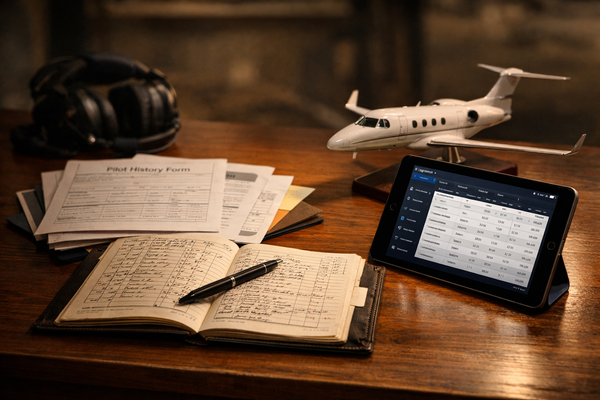
For all the professionalism in this industry, so much of the hiring and staffing process still runs on phone calls, text messages, spreadsheets, PDFs, old pilot history forms, incomplete records, scattered notes, and personal networks. A lot of it works only because experienced people have learned how to manually hold it together. But that does not mean it is efficient, and it definitely does not mean it is good for pilots.
If you are a pilot, especially a contract pilot, you already know this. You can spend years building valuable experience, investing in training, maintaining recency, paying for recurrent education, and working hard to establish a reputation for professionalism, only to still be stuck filling out the same information over and over again. Total time. PIC. Turbine. Multi. Instrument. Last 90 days. Last 12 months. Type experience. Insurance forms. Resume updates. Availability texts. Intro calls. References. It is repetitive, fragmented, and often far more manual than people outside the industry realize.
That problem may seem small to people who are not living it, but it has major downstream effects. It creates unnecessary admin work for pilots. It increases the likelihood of inconsistent or outdated information. It slows down hiring. It makes it harder for operators to evaluate pilots quickly and confidently. And it often leaves pilots feeling like they are being assessed through a patchwork of forms and inbox threads rather than through a clear, professional picture of who they are and what they bring to the table.
That is the problem Flying Company is built to solve.
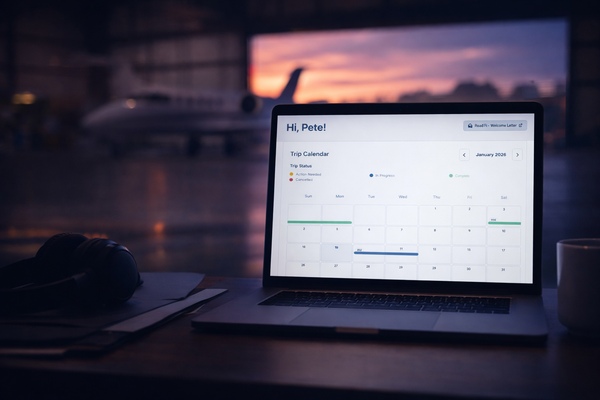
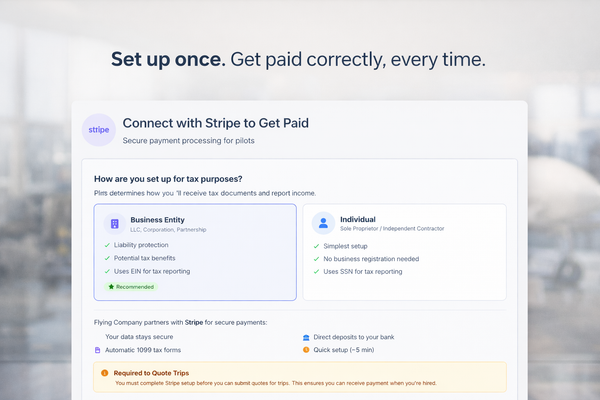
At its core, Flying Company helps aircraft owners and operators find, assess, hire, manage, and pay pilots. But I do not think of it as just a staffing platform. I think of it as infrastructure for a more professional aviation industry. The goal is not simply to help someone fill a trip. The goal is to modernize the systems around pilot hiring so that good pilots can present themselves more clearly, operators can make better decisions, and both sides can spend less time fighting process and more time focused on the actual mission.
For pilots, that matters in very practical ways.
First, it means reducing the administrative drag that has become normal in this part of aviation. Instead of repeatedly recreating the same information for different operators, the industry should be moving toward a cleaner and more standardized way for pilots to present their qualifications and experience. Pilots should not have to constantly re-prove basic information in slightly different formats every time a new opportunity comes up. A better system saves time, reduces friction, and helps ensure that the information being shared is actually current and accurate.
Second, it means helping pilots showcase more than just a few headline numbers. Aviation is full of capable professionals who do not always fit neatly into a simplistic checklist. Hours matter, of course, but they are not the whole story. Professionalism matters. Training matters. Recency matters. Specialized experience matters. Reliability matters. A pilot’s body of work is broader than a few fields on a form, and one of the things I care deeply about is creating a system that reflects that reality more honestly.
Third, it means creating more transparency and trust in an industry that still runs heavily on personal relationships and informal vetting. Relationships will always matter in aviation, and they should. But better systems can strengthen those relationships rather than replace them. When operators have better information and pilots have a better way to present themselves, trust becomes easier to establish. That benefits everyone.
Another thing I wanted to emphasize in the podcast is that Flying Company is not just about helping operators. It is very intentionally about helping pilots. Too often, new products in aviation are framed from the buyer’s perspective only. How does this help the operator? How does this help the company? How does this save time for management? Those are important questions, and Flying Company absolutely delivers value there. But the pilot side matters just as much.
Pilots are the ones who often bear the burden of broken systems. They are the ones updating forms at night. They are the ones chasing down old records. They are the ones trying to communicate availability across multiple channels. They are the ones whose experience can get flattened into incomplete summaries. They are the ones trying to break into new aircraft, new networks, or new opportunities without a modern system helping them do it. If we can make that process more organized, more transparent, and more professional, that is a win for pilots in a very real sense.
There is also a broader industry reason this matters. Aviation does not have an unlimited supply of experienced professionals. Whether people are talking about pilot shortages, maintenance shortages, dispatcher shortages, or just the increasing complexity of running a flight department well, the common theme is that the industry cannot afford to keep solving workflow problems by throwing more manual labor at them. We need better systems. We need better software. We need better ways to organize information and move people into the right opportunities faster and with more confidence.
That is part of the larger vision behind Flying Company. We are building tools that make staffing easier, but the bigger mission is helping aviation move away from fragmented legacy workflows and toward a more modern operating model. In the same way that other industries have built better digital infrastructure around hiring, credentials, communication, and payments, business aviation needs the same evolution. Pilots deserve that. Operators deserve that. The industry as a whole needs it.
That is why I appreciated the chance to go on the Pilot to Pilot podcast. It gave me the opportunity not just to talk about where I came from, but to explain why Flying Company exists in the first place. My background in special operations and corporate aviation gave me a front-row seat to how professionalism really works in aviation at a high level. It also showed me how much friction still exists in the civilian side of pilot hiring and staffing. Flying Company came from seeing that gap clearly and deciding it was worth fixing.
For pilots, I hope that message comes through loud and clear. This is not just a company built around filling trips. It is a company built around the idea that pilots deserve better tools, better systems, and a more professional way to manage opportunity, trust, and career progression in this industry.
That is what we talked about on the podcast, and that is what we are building every day at Flying Company.