Making UPRT Visible: APS + Flying Company

“This UPRT visibility is about better matches on both sides...Pilots with advanced UPRT are often seeking organizations that value skill, discipline, and safety, and Flying Company makes those connections easier to make"
APS CEO Paul ‘BJ’ Ransbury (CEO - Aviation Performance Solutions)
Loss of Control In-flight continues to be one of the leading causes of fatal aviation accidents worldwide. It doesn’t matter whether you are flying a piston single, a business jet, or a transport-category aircraft. When an aircraft departs controlled flight and the crew is unprepared, the consequences are often severe.
That reality is not new. What has changed over the years is our understanding of how to mitigate it.
Upset Prevention and Recovery Training has become one of the most meaningful ways professional pilots prepare for rare, high-consequence scenarios. Advanced UPRT is not about routine proficiency. It is about understanding aerodynamics at the edges of the envelope. It is about training the startle response. It is about building muscle memory and disciplined recovery techniques for situations most pilots hope they never encounter.
Pilots who take their profession seriously seek out that kind of preparation.
They do it not because it looks good on a resume, but because they understand what is at stake.
Today, Flying Company is making that commitment visible.
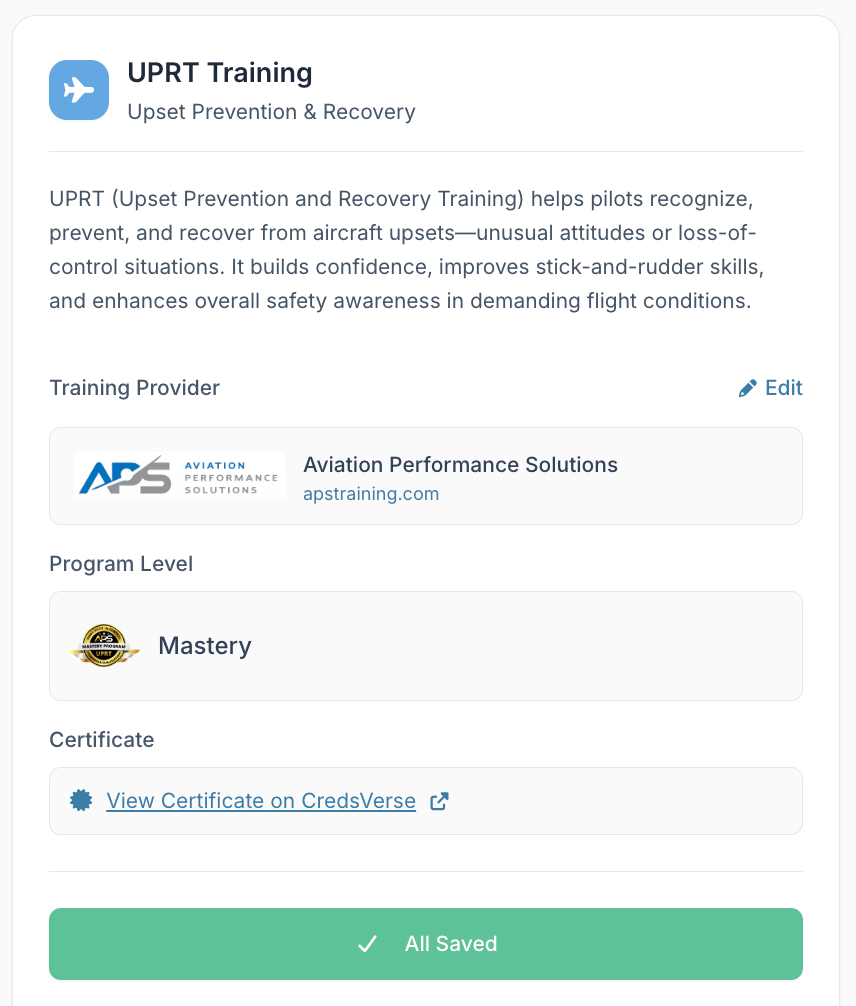
We have integrated verified Advanced UPRT credentials from Aviation Performance Solutions directly into pilot profiles. Pilots who have completed APS training can link to their certifier URL, giving operators immediate, verifiable insight into that credential inside the hiring workflow.
This matters because traditional hiring signals do not always reflect safety mindset.
Total time matters. Type ratings matter. Currency matters. But those metrics primarily reflect experience and qualification. They do not necessarily reflect how a pilot prepares for abnormal, unexpected, or high-stress events.
Advanced UPRT is different. It signals intentional safety investment. It reflects exposure to structured upset scenarios, energy management training, and recovery techniques grounded in research and real-world validation.
For flight departments, this integration provides clarity. Instead of scanning training history and wondering what a line item represents, you can now quickly identify whether a pilot has completed advanced UPRT aligned with APS’s Every Pilot In Control Solution Standard. It is transparent and verifiable.
For pilots, it creates alignment. Many highly skilled aviators want to work for organizations that value preparation, discipline, and safety culture. By making advanced UPRT visible, we help connect those pilots with operators who prioritize those same values.
This fits directly into the broader philosophy behind Flying Company.
From the beginning, the goal has been to move beyond surface-level qualifications and toward a more structured understanding of the Whole Pilot. That includes not only regulatory compliance and aircraft experience, but also the training choices that reveal professionalism and mindset.
Advanced UPRT is one of those choices.
Aviation will always involve risk. What separates professional operations is how intentionally they prepare for that risk. By integrating verified APS UPRT credentials into pilot profiles, we are making one of the most safety-critical training investments easier to see, easier to verify, and easier to factor into hiring decisions.
Because raising the standard in aviation hiring ultimately raises the standard in aviation itself.