LD Aviation Podcast


My Conversation on the LD Aviation Podcast
I recently had the chance to sit down with Lindsay Dyer for Episode 91 of the LD Aviation Podcast: The Future of Pilot Staffing.
Lindsay and her team at LD Aviation are some of the sharpest schedulers and dispatchers I’ve worked with. They live in the operational details every day. So this wasn’t just a high-level tech conversation. It was a practical discussion about how crew sourcing actually works inside a real flight department.
You can watch the full episode below:
How This Started
We began the conversation with a bit of background.
I didn’t grow up in aviation. I joined the Air Force after 9/11, went through pilot training, and eventually flew in Air Force Special Operations. I deployed six times and operated in 67 different countries. In that environment, I managed aircraft and crews at a high level, but the systems were already in place. The infrastructure was built.
When I transitioned into business aviation and became a chief pilot for a PC-24 in Arkansas, I quickly realized that managing an aircraft in the private sector is a completely different challenge.
Insurance requirements.
Open pilot warranties.
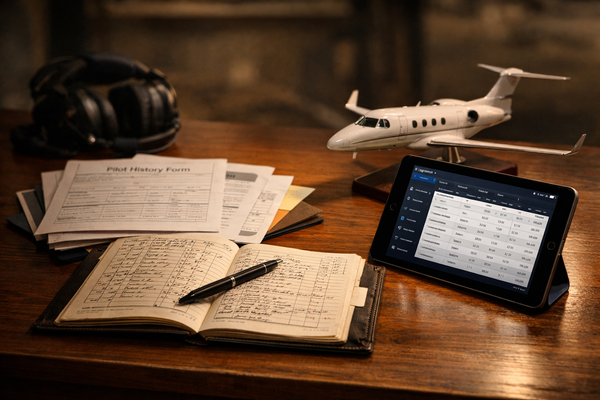
Pilot history forms.
Contracts.
Payments.
Travel logistics.
For the first year, we only had dual-pilot insurance. That meant every flight required me to find a qualified contract pilot. If we were flying once a week, I was spending several days before each trip sourcing someone, collecting paperwork, sending pilot history forms to the insurance broker, coordinating contracts, and making sure accounting had what they needed.
Sometimes everything came together the day before departure.
It wasn’t just frustrating. It felt unnecessary.
That friction is what led to Flying Company.
The Real Issue Isn’t Just Time — It’s Cycle Time
One of the more interesting parts of the podcast was when we talked about how much time flight departments actually spend sourcing pilots.
A large management company once told me their schedulers were spending about 25% of their week just finding and assessing contract pilots. But even more important than “touch time” is what I call cycle time.
How long does it take from the moment a trip is created to the moment a name is assigned to the schedule?
In some operations, that process can take four or five days. Text messages. Emails. Phone calls. Waiting for responses. Tracking down documents. Sometimes, after all of that, they still end up calling a staffing firm.
That’s not because schedulers aren’t capable. It’s because the tools are fragmented.
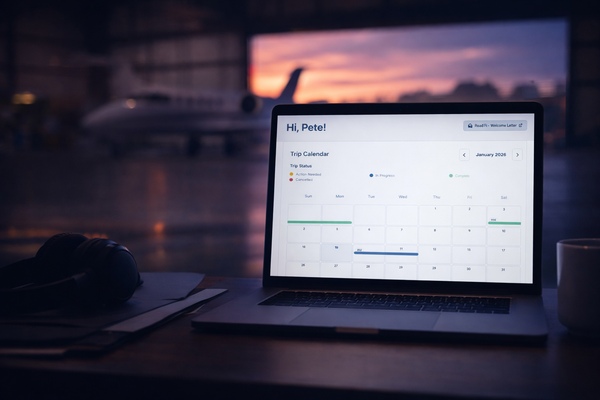
The goal with Flying Company is simple: give flight departments a way to find, assess, hire, and pay pilots in one place. Create the trip in a minute. Let pilots quote. Review profiles. Hire. Move on to higher-value work.
Schedulers and dispatchers are the quarterbacks of a flight department. They should be thinking forward, preventing problems before they happen. They shouldn’t be buried in redundant sourcing workflows.
Rethinking How We Evaluate Pilots
Another topic that’s important to me personally is moving beyond total time as the primary proxy for a pilot’s quality.
Hours matter, but they don’t tell the whole story.
You can have a 10,000-hour pilot who you wouldn’t fly with. You can also have a 2,000-hour pilot who is disciplined, professional, safety-focused, and highly competent.
When I deployed for the first time, I had around 250 hours total time. Hours alone are not a perfect measure of professionalism or judgment.
What I want to help build is a more holistic view of the “whole pilot.” That includes not just certificates and ratings, but things like recurrent training documentation, model-specific hours, NBAA credentials, participation in the WINGS program, UPRT training, and whether a pilot is operating as a professional services LLC.
The more context an operator has, the better their decision-making becomes.
Safety and the Fresh Set of Eyes
One feature we discussed that I’m especially excited about is post-flight safety reporting.
After a trip, a contract pilot can submit a safety report that routes directly back to the operator or into their Safety Management System. That matters more than people realize.
Contract pilots are often viewed as a cost on the balance sheet. But they also bring something valuable: perspective.
They’re not embedded in the culture. They haven’t flown the same routes with the same crew for years. They may notice procedural drift or small deviations from standard operating procedures that others have grown used to.
If there’s no mechanism for that feedback to reach the safety manager, the opportunity is lost.
Even small improvements in safety culture compound over time.
Cleaning Up the Back Office
Lindsay and I also talked about something less glamorous but very real: paperwork.
Pilots getting paid late.
Receipts missing.
Back-and-forth emails weeks after a trip.
1099s in January that no one wants to deal with.
When payments are integrated directly into the platform, one day of pilot services can be paid upfront to secure the trip. After the trip, pilots upload receipts, the operator reviews everything in one place, and Stripe handles the 1099 process automatically.
It doesn’t sound revolutionary. But anyone who has done back-office work in a flight department knows how much time this actually saves.
Sometimes the biggest improvements aren’t flashy. They’re operational.
Where This Is Heading
I don’t think aviation will look dramatically different overnight. But if you zoom out and look at other industries, highly credentialed professionals are already using intelligent marketplaces to work more flexibly.
Doctors.
Lawyers.
Travel nurses.
Aviation has been slower to adopt that model.
If we can reduce time spent sourcing crew, improve payment reliability for pilots, and raise the overall standard of professionalism and safety along the way, that’s meaningful progress.
Watch the Full Episode
If you’re a scheduler, dispatcher, chief pilot, aircraft manager, or contract pilot, I think you’ll find the conversation worthwhile.
You can also connect with Lindsay and her team at LD Aviation here: